Chess Opening Study Plan for Beginners
Build a simple repertoire in four weeks
The number of named chess openings can make a beginner feel unprepared before the first game even starts. The answer is not to memorize a little of everything. It is to build a small repertoire that repeatedly leads to sound positions you understand.
This four-week plan uses a minimum viable repertoire: one first-move plan as White, one response to 1.e4, and one response to 1.d4. Those three anchors do not predict every move your opponent can play. They give you a familiar starting point, while opening principles help you handle the sidelines.
What Is an Opening Repertoire?
An opening repertoire is your prepared set of choices at the start of a game. It should tell you more than which move comes next. For every opening you study, learn:
- the central squares you are fighting for;
- the usual squares for your minor pieces;
- when you normally castle;
- the pawn break that challenges the opponent's center;
- the common tactical mistake you need to avoid.
This knowledge remains useful after the game leaves a memorized sequence.
Principles Come Before Memorization
Beginner games often leave established opening theory within a few moves. That makes principles more reliable than a long forced sequence: control the center, develop pieces, protect your king, and check the opponent's threats.
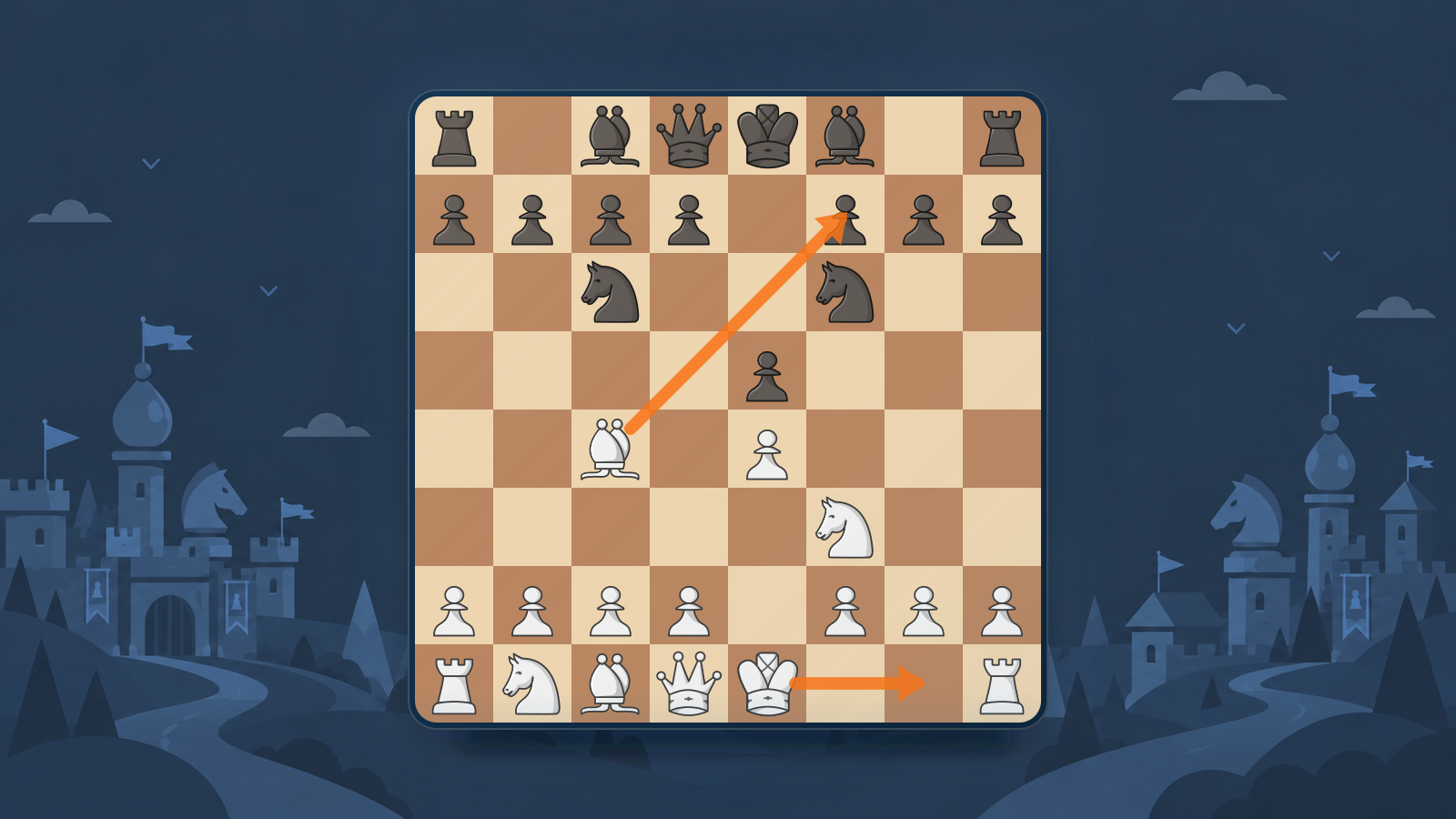
The Italian Game illustrates the approach. After 1.e4 e5 2.Nf3 Nc6 3.Bc4, White has claimed central space, developed two pieces, attacked e5 and f7, and prepared to castle. Learning why those moves work is more valuable than reciting several more moves without a plan.
How Much Theory Do You Need?
Start with the first three to five moves in your main positions and the ideas behind them. Add a line only after it appears in one of your games or solves a recurring problem. Our opening-depth guide gives a broader framework by rating.
Pro tip: Keep opening work a minority of your study time. Tactics, endgames, and reviewing your own games usually reveal more immediate ways to improve.
Choose One First Move as White
Both 1.e4 and 1.d4 are excellent. They tend to produce different kinds of positions, but neither is universally better for beginners.
| First move | Good starting system | Typical character |
| 1.e4 | Italian Game after 1...e5 | Open lines and early piece activity |
| 1.d4 | London System | Repeated development patterns and a solid center |
This plan uses 1.e4 and the Italian Game as its main example. If you prefer 1.d4, use the London as an alternative first-move plan. Do not try to switch from 1.e4 to the London after seeing Black's reply—the choice is made on White's first move.
The Italian Game as Your White Anchor
The Italian begins 1.e4 e5 2.Nf3 Nc6 3.Bc4. Its moves visibly reinforce development and central control, and its open positions provide useful tactical lessons. Your opponent will not always answer 1.e4 with 1...e5, so also learn how to make principled moves against unfamiliar defenses rather than attempting to prepare every branch at once.

| 1 | e4 | e5 |
| 2 | Nf3 | Nc6 |
| 3 | Bc4 | Nf6 |
The London as an Alternative
The London normally starts with 1.d4, Nf3, Bf4, and e3. The repeated piece placement reduces the initial theory burden, although it is not an automatic setup: White still needs to react to Black's central breaks and pressure on b2.
Choose the London instead of the Italian if you prefer its structures. One well-understood White plan is enough for your first month.
Choose Two Responses as Black
Black cannot choose White's first move, so the minimum repertoire needs at least one answer to 1.e4 and one to 1.d4. A coherent starting set is:
| Opponent plays | Repertoire anchor | First idea |
| 1.e4 | Caro-Kann Defense with 1...c6 | Prepare ...d5 and challenge the center |
| 1.d4 | 1...d5 with a Queen's Gambit Declined setup | Support the center with ...e6 and develop naturally |
These are practical foundations, not shortcuts around understanding. You still need to examine the opponent's threats on every move.
Caro-Kann Against 1.e4
After 1.e4 c6, Black prepares ...d5. The basic plan is easy to state: challenge White's center, develop the light-squared bishop when possible, then complete development and castle. Learn the positions you actually encounter rather than trying to memorize every named variation immediately.
| 1 | e4 | c6 |
| 2 | d4 | d5 |
A ...d5 Setup Against 1.d4
Meet 1.d4 with 1...d5. If White plays 2.c4, supporting the center with 2...e6 leads to the Queen's Gambit Declined. Black can develop with ...Nf6 and ...Be7, castle, and decide later how to challenge White's center.
| 1 | d4 | d5 |
| 2 | c4 | e6 |
| 3 | Nc3 | Nf6 |
| 4 | Nf3 | Be7 |
| 5 | Bg5 | O-O |
To see the opening's central ideas in more detail, read the Queen's Gambit guide.
A Four-Week Opening Study Plan
| Week | Focus | Result |
| 1 | Principles and your first move | Choose 1.e4 or 1.d4 and explain the purpose of each early move |
| 2 | Your White anchor | Learn the Italian after 1...e5, or the London as your chosen alternative |
| 3 | Black against 1.e4 | Build a basic Caro-Kann plan |
| 4 | Black against 1.d4 and review | Build a ...d5 setup and repair problems found in your games |
Week 1: Learn Principles and Choose
Review center control, development, king safety, and tactical awareness. Then choose 1.e4 or 1.d4 and keep that choice for the month. For every move you record, write a one-sentence reason. If you cannot explain a move, it is not ready to become part of your repertoire.
Play several slower games this week. Rapid time controls give you enough time to notice when the opponent's move changes your normal plan.
Week 2: Build Your White Anchor
If you chose 1.e4, study the Italian position after 1.e4 e5 2.Nf3 Nc6 3.Bc4. If you chose 1.d4, study the first London setup instead. Learn one typical pawn break, one common tactical danger, and where each minor piece normally belongs.
After every game, stop your review at the first position where you did not know what to do. That position—not a random database line—is the best candidate for your next short study session.
Week 3: Add the Caro-Kann
Practise 1.e4 c6 2.d4 d5 from Black's side. Look at White's common ways to resolve or maintain the central tension, then play training games with the goal of developing safely rather than proving that every move was perfect.
Use spaced repetition if it helps you retain positions, but attach an explanation to every move. A flashcard should test the plan as well as the notation.
Week 4: Add ...d5 and Review
Practise 1.d4 d5 and the Queen's Gambit Declined setup after 2.c4 e6. Then review the month's games and group your mistakes:
- Did you forget a move, or misunderstand its purpose?
- Did you miss a direct threat?
- Did you reach a playable middlegame and blunder later?
Only the first category clearly calls for more opening work. Tactical misses belong in theme-based puzzle practice, while later positional errors are better addressed by reviewing the whole game.
Common Beginner Opening Mistakes
Studying Too Many Openings
Sampling a new opening after every loss prevents useful patterns from repeating. Keep the same three anchors for enough games to identify genuine recurring problems.
Memorizing Without Understanding
Knowing that a move is popular does not tell you what to do after an opponent deviates. Add the purpose, the typical continuation, and the relevant danger to every position you save.
Blaming the Opening for a Later Blunder
A playable position followed by a missed fork is not evidence that the repertoire failed. Find the move that changed the evaluation before deciding what to study.
Playing the Setup Automatically
Systems reduce the number of unfamiliar decisions; they do not remove calculation. Always check forcing moves before continuing with your usual development.
What to Do Next
Spend most of your improvement time on tactics, basic endgames, playing, and reviewing your games. Use a smaller portion to maintain the openings that actually appear. The exact split should reflect your weaknesses rather than a universal percentage.
Once the three anchors feel familiar, expand in response to evidence. Add one answer to a line you repeatedly face, learn the plan behind it, and test it in real games before adding another. Browse the openings directory when you need that next branch, or play a game to begin collecting useful positions.