Queen's Gambit
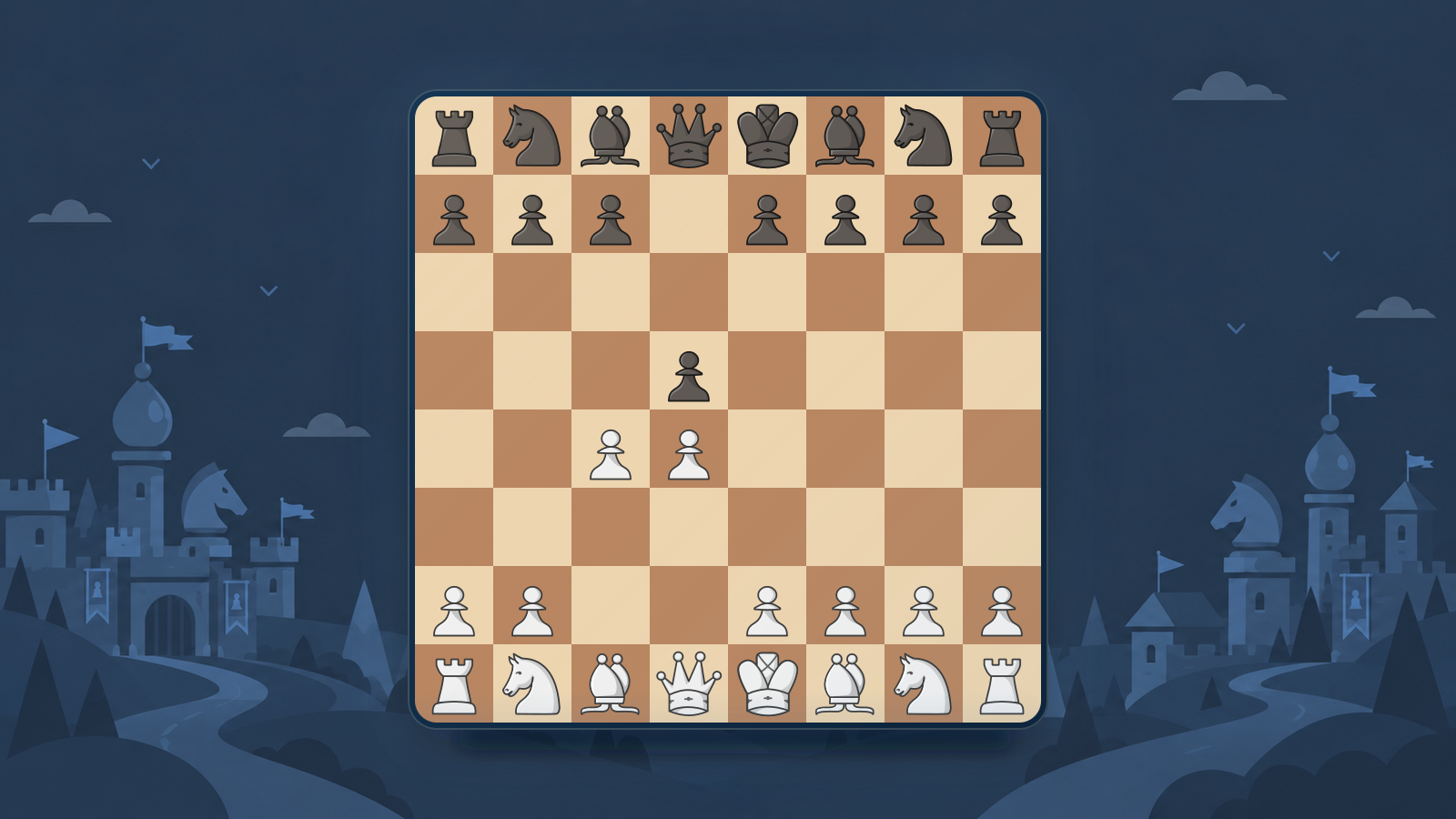
Opening at a glance
- Starting moves
- 1.d4 d5 2.c4
- ECO
- D06–D69
- Played by
- White
- Level
- Beginner, Intermediate, Advanced
- Character
- Positional, Strategic
Key ideas
- Challenge Black's d5 pawn with the c-pawn
- Build central control and active piece play
- Use the resulting pawn structure to guide the middlegame plan
Main variations
- Queen's Gambit Accepted2...dxc4
- Queen's Gambit Declined2...e6
- Slav Defense2...c6
The Queen's Gambit at a glance
The Queen's Gambit begins with 1.d4 d5 2.c4. The c-pawn attacks Black's d5-pawn and asks how Black intends to maintain a foothold in the centre. Black can capture with 2...dxc4, enter the Queen's Gambit Declined with 2...e6, or defend d5 with 2...c6 in the Slav Defense. The name is slightly misleading: after 2...dxc4, White can usually regain the pawn, while Black often returns it voluntarily to gain time for development and counterplay.
What the Queen's Gambit actually is
The Queen's Gambit has been played at the highest level for generations. Its idea is simple: White uses a flank pawn to challenge a central pawn. If Black exchanges on c4, White may later build a centre with e4 or recover the pawn through e3 and Bxc4. If Black maintains the pawn on d5, the tension shapes both sides' development and pawn breaks.
The opening moves: 1.d4 d5 2.c4
The Queen's Gambit begins with 1.d4 d5 2.c4. White opens by advancing the d-pawn to the center, Black mirrors with the d-pawn, and then White immediately pushes the c-pawn two squares forward to challenge Black's central foothold.

| 1 | d4 | d5 |
| 2 | c4 |
That c-pawn move is the heart of the opening. White would be happy to exchange the c-pawn for Black's more central d-pawn, but Black is not forced to capture. The response determines the pawn structure and the plans that follow.
Is it really a gambit?
The word "gambit" normally describes a deliberate material sacrifice for activity, development, or an attack. The Queen's Gambit is different because White often recovers the pawn on c4. Black can try to keep it in some variations, but doing so usually requires time and queenside pawn moves that give White central space or attacking chances.
The c4-pawn is therefore better understood as a strategic lever than a pawn White expects to lose permanently.
This distinction matters practically. White should use the pressure on d5 to develop naturally and improve the centre, not rush to recover material at any cost.
The strategic ideas behind the moves
Understanding the ideas behind the moves matters more than memorising a long sequence. The opening's plans come from the pawn structure Black chooses.
When White plays 2.c4, the immediate goal is to put pressure on Black's d5 pawn. If Black captures on c4, White usually seeks to recover the pawn while developing actively. If Black holds d5, a tension remains in the centre that White can exploit through piece activity and pawn breaks. Either way, White is fighting for control of central squares such as e4.
White's plan: central pressure and space
White's strategic ambitions in the Queen's Gambit revolve around three connected ideas:
- Central pressure: The pawn on c4 attacks d5; it does not defend White's pawn on d4. White often increases the pressure with Nc3 and develops around the resulting tension.
- Active development: White commonly develops with Nf3, Nc3, and Bg5 or Bf4 before deciding whether to play e3, exchange on d5, or prepare e4.
- Structure-specific plans: A minority attack is especially relevant in the Exchange QGD after cxd5 exd5, when the Carlsbad structure gives White a queenside pawn minority to advance against Black's pawn chain. It is not an automatic plan in every Queen's Gambit position.
The important lesson is to read the pawn structure before choosing a plan. The same opening moves can lead to very different middlegames.
Black's plan: solid defence and counterplay
Black wants to complete development, challenge White's centre, and avoid spending too many tempi on the pawn at c4. The usual freeing breaks are ...c5 or ...e5, but their timing depends on the variation.
In the QGD, Black supports d5 with ...e6 but temporarily restricts the light-squared bishop. In the Slav, ...c6 supports d5 while keeping the c8-bishop's diagonal open. In the QGA, Black releases the central tension immediately and plays against White's centre with active development.
Accepted, declined, or Slav: Black's main choices
After 1.d4 d5 2.c4, three major response families account for much of established theory. Each one produces a distinct development problem and pawn structure.
Queen's Gambit Accepted (QGA)
With 2...dxc4, Black exchanges the d5-pawn for White's c-pawn and temporarily holds an extra pawn on c4. White gains freedom in the centre, while Black aims for quick development and pressure against d4.
| 1 | d4 | d5 |
| 2 | c4 | dxc4 |
| 3 | Nf3 | Nf6 |
| 4 | e3 | e6 |
| 5 | Bxc4 | c5 |
White usually recovers the pawn, but not always immediately. Black should use the time White spends on recovery to develop and attack the centre. Trying to keep the pawn at all costs can be dangerous, although sound ...a6 and ...b5 systems do exist and require concrete knowledge from both players.
Queen's Gambit Declined (QGD)
With 2...e6, Black reinforces d5 and enters the Queen's Gambit Declined. The position is solid, but the pawn on e6 temporarily blocks Black's light-squared bishop. Black normally develops the kingside and prepares a freeing pawn break.
| 1 | d4 | d5 |
| 2 | c4 | e6 |
| 3 | Nc3 | Nf6 |
| 4 | Nf3 | Be7 |
White can maintain the tension, exchange on d5, or prepare a central expansion. A queenside minority attack becomes relevant after the Exchange Variation creates a Carlsbad structure; it is one plan among several, not a universal QGD recipe.
Slav Defense
With 2...c6, Black also supports d5 but leaves the light-squared bishop free to develop. This is the Slav Defense, not the Queen's Gambit Declined. Slav positions can be solid or highly tactical depending on whether Black later captures on c4 and how both sides develop.
The three responses can be summarized by their general character:
- QGA (2...dxc4): Black surrenders the center for active piece play and dynamic counterchances
- QGD (2...e6): Black supports d5 with a compact, solid setup but must solve the c8-bishop
- Slav (2...c6): Black supports d5 without blocking the light-squared bishop
All three are sound, established responses. The best choice depends on the structures and plans the player wants to learn.
Mistakes beginners make in this opening
Beginners encountering the Queen's Gambit for the first time tend to repeat a handful of recognisable errors, and understanding them is more valuable than memorising any specific line.
Beginners may make several recurring mistakes:
- Thinking that c4 protects d4. It does not. The c4-pawn attacks d5, so White still has to watch pressure against the d4-pawn.
- Trying to keep the c4-pawn at any cost. Accepting is sound, but extra pawn moves can leave Black behind in development. If Black chooses a theoretical ...a6 and ...b5 setup, it must be played accurately.
- Launching the same plan in every structure. The minority attack belongs mainly to Carlsbad structures. Other Queen's Gambit positions call for central play, development, or kingside activity instead.
- Neglecting development as White. White should not push e4 automatically or rush to recover c4 before the pieces are ready. Natural development keeps the centre flexible.
The underlying principle connecting all these errors is the same: prioritising material or short-term threats over development and structure. An early queen move often loses time — if your queen is chased by a developing piece, your opponent gains time toward completing development. The Queen's Gambit rewards players who understand why each move is made, not those who follow a memorised sequence and then improvise. Keeping that idea in mind will serve you far better than any specific move order.
Key takeaways
The Queen's Gambit is one of the most recognisable openings in chess, and its core ideas are straightforward enough to grasp in a single sitting.
What is the Queen's Gambit and what are its moves?
After 1.d4 d5, White plays 2.c4 to attack Black's d5-pawn with a flank pawn. White would welcome an exchange of the c-pawn for Black's central pawn, but Black has several sound ways to maintain or release the tension.
Is the Queen's Gambit a true gambit?
It is not usually a permanent pawn sacrifice. White commonly regains the pawn after 2...dxc4, while Black uses the time to develop and challenge the centre. Some variations allow Black to keep the pawn, but only with concrete play and structural or developmental concessions.
What is the difference between Queen's Gambit Accepted and Declined?
The Queen's Gambit Accepted begins with 2...dxc4. The Queen's Gambit Declined begins with 2...e6, supporting d5. The popular 2...c6 is the Slav Defense, a separate opening family.
Is the Queen's Gambit good for beginners?
Yes. Its central idea is easy to understand, and the opening teaches development, pawn tension, and structure. Beginners should learn one simple response to the QGA, QGD, and Slav rather than memorising many variations.
Next, practise the moves in the interactive Queen's Gambit lesson, explore the openings directory, or use the beginner opening study plan to fit this opening into a small repertoire.