Opening Principles for Blitz Chess
What changes under time pressure—and what still matters
Blitz does not overturn the principles of good opening play. You still need to control the center, develop pieces, and protect your king. What changes is the value of familiarity: a sound position you understand and can reach quickly is often more useful than a theoretically sharper position that consumes half your clock.
Under FIDE's blitz definition, each player has 10 minutes or less for the game, or a time allocation where the starting time plus 60 increments totals 10 minutes or less. In that environment, your opening should reduce unnecessary decisions without encouraging automatic, careless moves.
Why Opening Priorities Change in Blitz
In a long game, spending several minutes recalling or calculating an opening detail can be reasonable. In a three-minute game, it can consume a large part of your available time. The principles stay the same; the preparation strategy changes.
Familiar Positions Beat Maximum Theory
Deep preparation only helps while the game remains inside a line you remember and understand. Club-level opponents often deviate early, so memorizing 15 moves without learning the resulting plans can leave you stranded as soon as the position changes.
A practical blitz repertoire should help you answer three questions quickly:
- Where do my minor pieces usually belong?
- What pawn break am I preparing?
- What could make my normal setup unsafe in this position?
That last question matters. A familiar setup is a guide, not permission to ignore your opponent's threats.
Spend Time Where the Position Demands It
Routine developing moves should usually be quick. Forcing positions deserve more time—even in the opening. Before moving automatically, scan for checks, captures, threats, and tactical changes caused by the opponent's last move.
The goal is not to play every opening move within an arbitrary number of seconds. It is to save time in familiar positions so you can spend it when the board presents a real decision.
Opening Principles That Still Hold Up
Three classical ideas become even more valuable under time pressure:
- Efficient development — bring pieces into the game without wasting tempi.
- Useful activity — place pieces where they influence the center or create concrete pressure.
- King safety — remove tactical targets before the position opens.
Activity Without Carelessness
Active pieces make your opponent solve problems, but activity is not the same as aggression. A naturally developed bishop that supports the center is useful. An early queen sortie that can be chased may hand your opponent free development and cost you time on every retreat.
Favor moves that do more than one job: develop with tempo, defend while improving a piece, or prepare castling while controlling the center. These moves are easy to understand and remain useful when the game leaves theory.
Castle When It Is Safe and Useful
Castling is usually an efficient way to protect your king and connect your rooks, so it should be part of most blitz plans. But do not castle automatically into an attack or ignore a forcing tactic in the center.
Pro tip: Make early castling your default, then override that default when the position gives you a concrete reason.
Build a Minimum Viable Blitz Repertoire
A minimum viable repertoire is the smallest set of prepared ideas that gets you into playable, familiar middlegames. Start with three anchors: one plan as White, one defense against 1.e4, and one defense against 1.d4. These anchors will not cover every possible move, so learn the principles for handling sidelines too.
| Situation | Repertoire anchor | Why it is practical |
| White | London System | Repeated piece placement and clear development |
| Black vs. 1.e4 | Caro-Kann Defense | A direct central plan with a sound structure |
| Black vs. 1.d4 | ...d5 and ...e6 setup | Natural development and familiar Queen's Gambit structures |
This is one sensible beginner-friendly set, not the only correct repertoire. If you already understand another sound opening, familiarity may matter more than switching.
London System as White
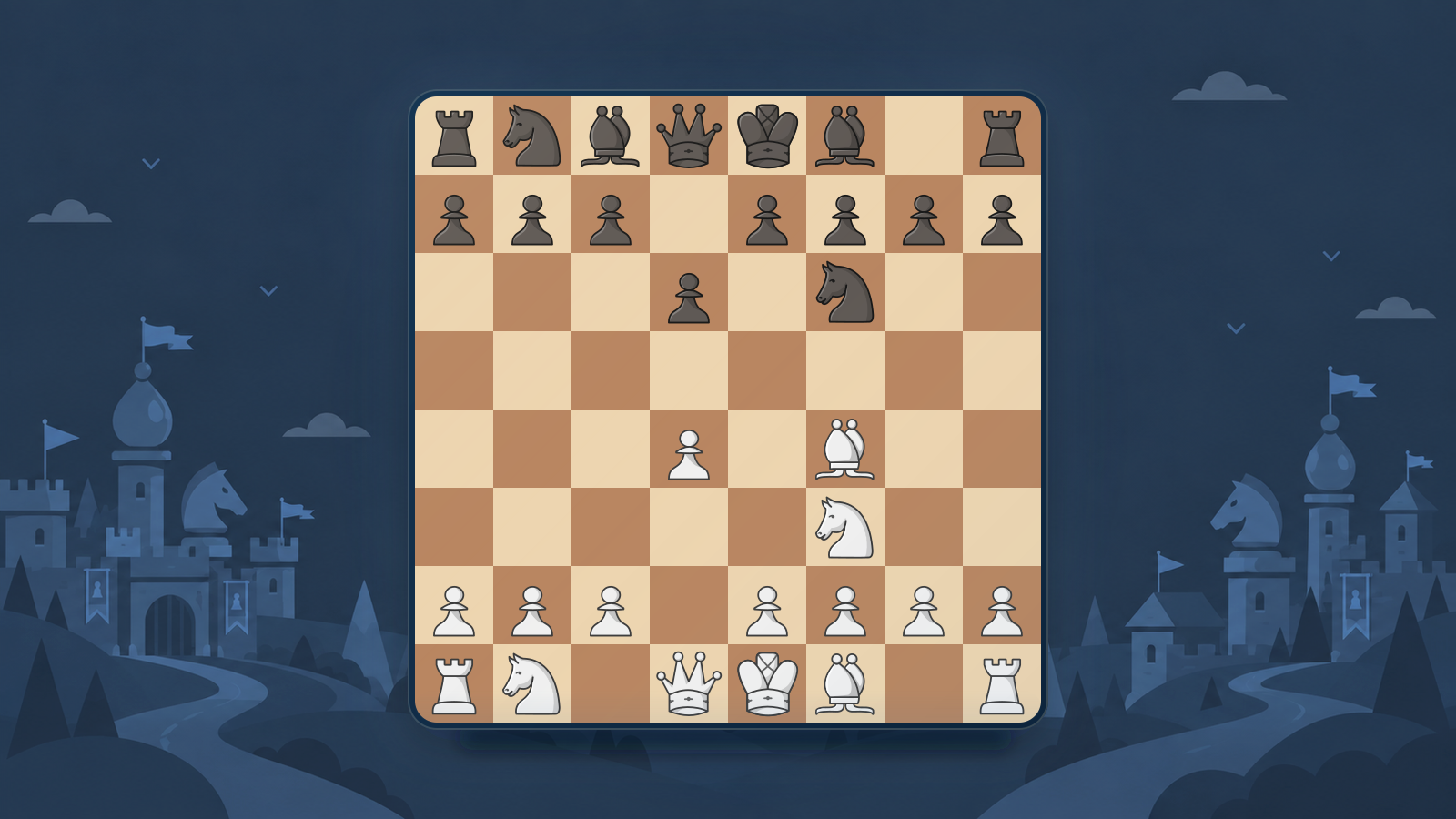
The London often develops the queen's bishop before closing the pawn chain, then follows with e3, Nf3, and castling. Its recurring structure makes it easier to recognize plans quickly, but Black's moves still matter: White must watch for early ...c5, ...Qb6, and changes in the center.

| 1 | d4 | d6 |
| 2 | Nf3 | Nf6 |
| 3 | Bf4 |
Caro-Kann Against 1.e4
After 1.e4 c6, Black prepares ...d5 and challenges White's center. The structure is generally sound, but the Caro-Kann is not theory-free. Learn what to do against White's main second moves, then focus on developing the light-squared bishop before playing ...e6 when the position allows it.
A ...d5 Setup Against 1.d4
Starting with 1...d5 gives Black a clear claim in the center. Against 2.c4, a Queen's Gambit Declined setup with ...e6, ...Nf6, and ...Be7 is a dependable foundation. The positions teach central tension and development without requiring a different setup for every quiet move.
Common Blitz Opening Mistakes
- Recalling moves without checking the board. A familiar pattern may fail because one piece or pawn is placed differently. Scan for tactics before following the template.
- Using too much time on routine choices. Review repeated opening positions after your games so the normal moves become easier to recognize.
- Playing instantly in a forcing position. Checks, captures, and direct threats deserve calculation even when the clock is low.
- Switching openings after every loss. Review whether the opening caused the defeat before replacing it. Many games are decided by a later tactical error.
- Confusing a playable move with the best move. In blitz, a familiar sound choice is useful, but a quick blunder is still a blunder.
Pro tip: Your target is not instant play. It is fast recognition of familiar positions and deliberate thought when something changes.
Key Takeaways
- Center control, development, and king safety remain essential in blitz.
- A narrow repertoire saves time because you repeatedly reach structures you understand.
- Learn plans and tactical warning signs, not only move sequences.
- Use saved opening time on the first genuinely forcing or unfamiliar position.
- Review your games to find recurring decisions that should become automatic next time.
Build the foundation with the beginner opening study plan, check how deeply to study each opening, then test your repertoire in a game on Chess Hotel.